
The Phantom Case: Claimed Victims And Disputed Shadows
There are two Zodiac cases.
The first one is ugly enough by itself: five confirmed dead, two wounded survivors, authenticated letters, phone calls, ciphers, a hood at Lake Berryessa, a cab driver's shirt mailed to newspapers, and a killer who understood publicity so well that he made the press part of the weapon.
The second case is larger, murkier, and much harder to kill.
That is the phantom case.
It is made of disputed victims, claimed victims, related cases, possible letters, handwriting opinions, suggestive geography, lookalike attacks, and unsolved crimes that drifted toward Zodiac because the real Zodiac left room for them. He claimed numbers law enforcement could not confirm. He hinted. He bragged. He absorbed other stories into his own mythology. Then the public did the rest.
This is where the case starts behaving less like a police file and more like a fog machine.
An unsolved young woman in Riverside. A terrified mother and child on a dark highway. A missing nurse in Tahoe. A murdered cab driver years before Paul Stine. A young couple shot on a remote beach six years before Lake Berryessa.
Some of these cases deserve serious attention. Some deserve only a cautious note. None deserve to be smuggled into the confirmed Zodiac count because the resemblance feels eerie.
Eerie is not evidence.
I know. It is rude of evidence to be this way.
The Rule Before The Fog
Before we step into the disputed cases, we need a rule.
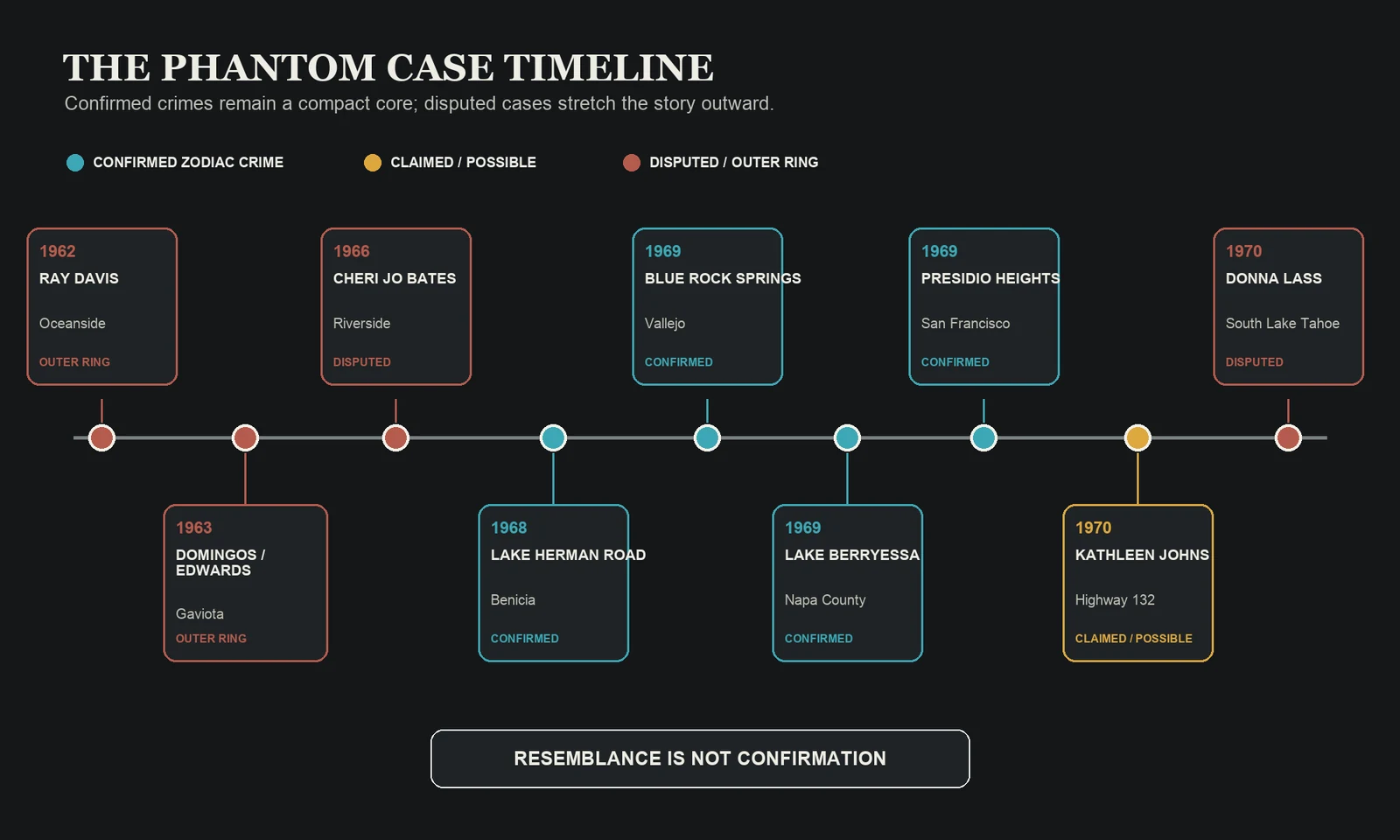
The confirmed Zodiac victim count in this series remains five dead and two survivors: David Faraday, Betty Lou Jensen, Darlene Ferrin, Michael Mageau, Cecelia Shepard, Bryan Hartnell, and Paul Stine.
That is not because Zodiac was honest, humble, or inclined to undersell himself. Quite the opposite. In the July 26, 1970 "Little List" letter, the Department of Justice material records Zodiac claiming thirteen victims while law enforcement could definitely link him to five murders. His later persona depended on the gap between what police could prove and what he wanted the public to imagine.
That gap is where the phantom case lives.
So for this article, the categories matter.
A confirmed Zodiac crime is one tied to the established case by reliable evidence: survivor testimony, police investigation, authenticated communications, physical evidence, or a combination strong enough that law enforcement treated it as part of the main series.
A claimed case is one Zodiac appeared to take credit for, or imply credit for, without giving enough proof to settle the matter.
A related or disputed case is one investigators, document examiners, writers, or later researchers connected to Zodiac in some meaningful way, but without enough weight to make it confirmed.
A rumor is what happens when everyone gets tired of boring standards and starts throwing darts at California.
We will not be doing that.
Riverside: The Case That Almost Belongs
Cheri Jo Bates is the strongest disputed case.
That does not mean she was a Zodiac victim.
It means this is the disputed case with the most serious official paper trail, and the one most likely to punish lazy language.
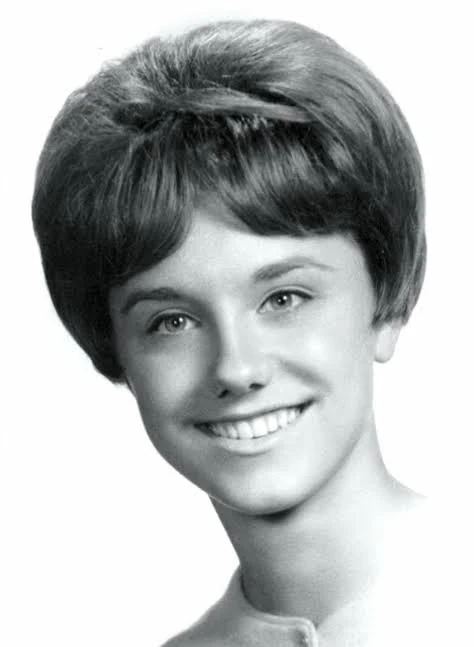
Bates was 18 years old, a Riverside City College student, and a recent Ramona High School graduate. On the night of Sunday, October 30, 1966, she went to the college library. Police believed she was there during the evening, and the available case summaries place the murder window between roughly 9:23 p.m. and 12:23 a.m.
Her Volkswagen Beetle was found near the library. It had apparently been disabled while she was inside, leaving her with a car that would not get her home. Her body was found about 100 yards away in an alley on the Riverside City College campus.
The attack was violent and personal in the physical sense, though that does not mean the motive was personal. Bates had been beaten and stabbed with what was described as a short-bladed knife. Her throat was cut. There was no evidence of robbery or sexual assault. There were no witnesses who could resolve the case.
Investigators found items that have kept the case alive in the Zodiac orbit ever since: a men's Timex watch, a military-style heel print, and the disabled car. The watch has its own little mythology because it suggested a wrist size and a possible military purchase trail. The shoe impression mattered because nearby March Air Force Base gave later writers a place to point. But none of those things, by themselves, spell Zodiac. They are case facts first, theory fuel second.
That alone does not make Zodiac.
Young woman killed near a library? Not enough.
Disabled car? Interesting, but not enough.
No obvious motive? Unsettling, but still not enough.
What makes Riverside matter is what came after the murder.
In late November 1966, a typed "Confession" letter was mailed in Riverside. It claimed responsibility for Bates's murder and, according to later FBI material, described details of the crime and the disabling of her car that would have been known only to the unknown subject who killed her. That is not the same as proving Zodiac wrote it. It does mean the letter was not just ordinary crank mail, at least as federal investigators later understood the file.
Then came the April 30, 1967 letters: short, handprinted messages sent to Riverside police, the local newspaper, and Bates's father. The infamous phrase was brief and brutal: "Bates had to die."
There was also the desk poem, scratched or written onto a desktop at the college library and later collected into the comparison universe. The exact authorship of that poem is a swamp. But it became part of the official comparison trail, and that is what matters here.
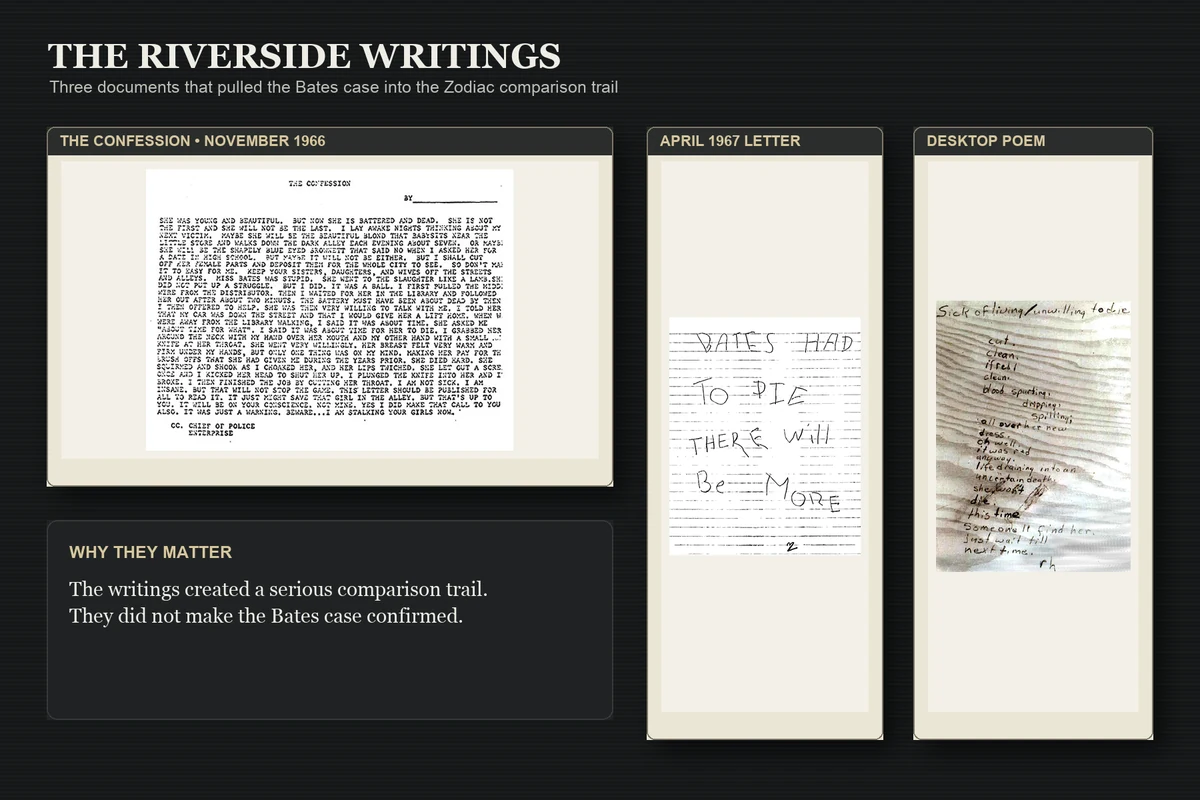
By 1970, the Zodiac case was no longer just a Bay Area murder investigation. It was a public monster. Investigators began looking backward. Riverside saw similarities. Bay Area investigators paid attention. The Department of Justice material reports that document examiner Sherwood Morrill gave a November 16, 1970 opinion linking Riverside/Bates handprinting and desk-poem material to Zodiac letters. The DoJ material also records investigators from San Francisco, Napa, DoJ, and Riverside exchanging information and collecting handprinting exemplars and prints from Bates suspects for comparison.
That is real heat.
It is also not confirmation.
A handwriting opinion can support an investigative link. It cannot move a murder into the confirmed Zodiac count by itself. Especially not a murder from 1966, before the name Zodiac appeared, before the authenticated Bay Area letter campaign, and before the confirmed pattern took its public shape.
The FBI material is equally important and equally limited. Federal files show Riverside material being compared and circulated. They show that several fingerprints and partial palm prints remained unidentified and were being compared against other latent submissions. They show interest, process, and seriousness.
They do not show the clean finish line.
This is where Riverside becomes the perfect test of discipline. If you want to argue that Bates may belong in the Zodiac orbit, you have material to work with. The post-crime letters matter. The vehicle disabling matters. The official handwriting comparison matters. The later Los Angeles Times letter, in which Zodiac pulled Riverside toward himself, matters.
But none of that lets us write, "Cheri Jo Bates was definitely a Zodiac victim," unless we are willing to make the word "definitely" perform community theater.
The strongest argument against Bates may be Zodiac's own silence. During the confirmed-crime period, he repeatedly authenticated himself: Lake Herman Road, Blue Rock Springs, Berryessa, Presidio Heights, dates, calls, shirt pieces, and case details. But he did not include Riverside when he was building the original trophy list. He did not write the Bates date on Hartnell's car door. He did not offer Bates-specific proof when proof was his favorite weapon. His Riverside claim came later, after the possible connection had already gone public. That does not eliminate Bates, but it makes the case feel less like a hidden confession and more like a shadow he may have decided to wear once someone else held it up.
Modern Riverside statements complicate the story further. Riverside authorities have publicly resisted the Zodiac linkage and have treated Bates as a local unsolved homicide, not as a confirmed Zodiac crime. Later developments around at least one Riverside letter lane also caution against treating every old piece of Zodiac-adjacent writing as automatically authentic. That does not erase the older official comparison work. It does mean the case has to be held in tension.
Bates is not internet fluff. She is not a random add-on.
She is the strongest disputed case because the paper trail is serious enough to earn the argument.
And she remains disputed because the argument still does not become proof.
Heat: high disputed-case heat, not confirmed.
Kathleen Johns: The Roadside Nightmare
Kathleen Johns is the claimed case that sounds most like a campfire story until you remember there was a real woman and a real baby in it.
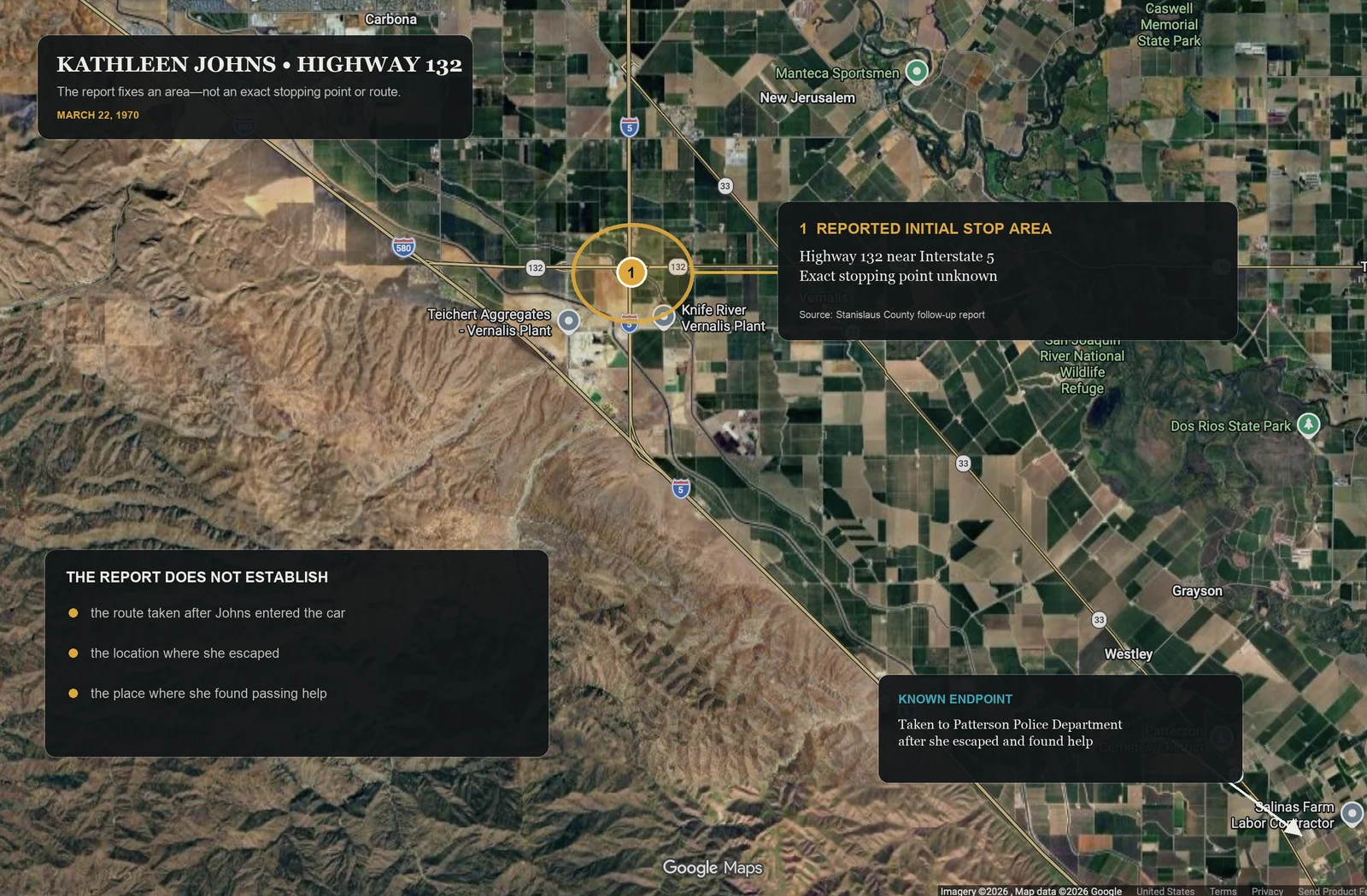
On Sunday, March 22, 1970, Johns was driving near Patterson, California, with her infant daughter. She was 22 years old. In the police-report version, she noticed a late-model, light-tan vehicle behind her on Highway 132. The driver flashed his lights on and off, apparently trying to get her to stop.
Johns pulled over. The man approached and told her that her left rear wheel was wobbling. He said he would tighten the lug nuts. According to the report, Johns stayed in her own vehicle while he took a tire iron from her trunk and worked near the wheel. He then told her it was safe to proceed, and left.
That was not the end of it.
Johns then tried to pull away from the curb, and the car lurched to a stop almost immediately. When she got out, the left rear wheel had come off and was attached only by one lug bolt. The same man then reappeared and offered to take her to a service station.
That is the terrifying hinge of the story. Help becomes captivity.
Instead of delivering Johns and her daughter safely, the man drove them around rural roads for roughly an hour to an hour and a half, possibly near Tracy. Johns later said the driver threatened to kill her and her daughter. The police report, however, does not record that explicit threat. It says Johns became frightened because she believed he might intend to harm her or her daughter, and that when she asked whether he was going to stop, he avoided the question and kept talking about something else.
The report describes the man as about 30 years old, roughly 5'9", about 160 pounds, with dark hair, black-rimmed plastic glasses, a white shirt, and dark blue bell-bottom pants. Johns eventually escaped while carrying her child after the vehicle stopped. She ran into a nearby field, hid, and later found help. Her car was later found burned.
That is the human core of the case. Not a symbol. Not a cipher. Not a suspect matrix. A mother and child on a dark road with a stranger who may have deliberately disabled their car.
The Zodiac link comes later.
Johns reportedly identified the wanted-poster image as the man who abducted her. Newspapers covered the incident. Then, on July 24, 1970, Zodiac mailed a letter to the Chronicle that appeared to refer to the woman and baby. He did not, however, give the kind of private, case-settling detail that would let the claim stand up straight on its own.
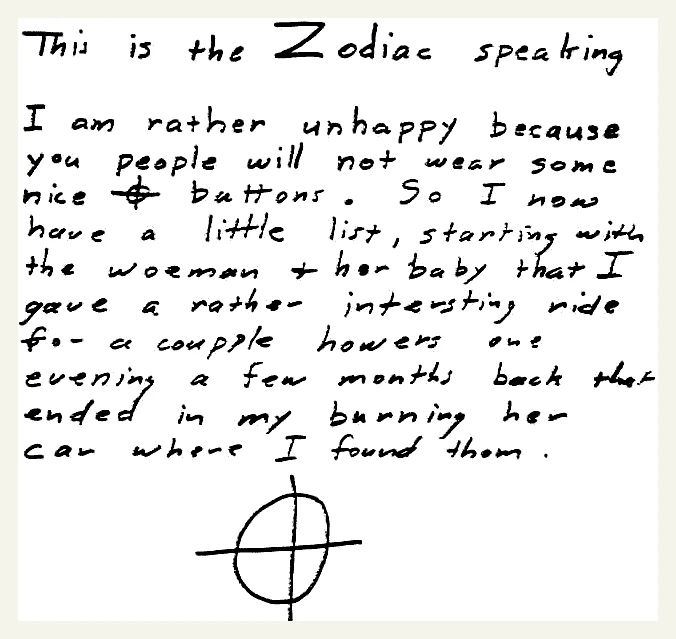
That is the problem.
Zodiac was very good at taking credit. He was less generous with proof when proof did not serve him. In the Stine murder, he mailed pieces of the victim's shirt. That was not subtle. It was authentication by trophy. With Johns, the claim sits in a weaker register: suggestive, probably deliberate, but not locked.
The police-report trail also has to be handled carefully. Later retellings emphasize threats and terror. Some report material is thinner than the famous version of the story. That does not mean Johns invented the event. Trauma, shorthand police writing, report lag, and later reconstruction can all create gaps. But those gaps matter if we are trying to decide whether Zodiac personally did it.
This is exactly the kind of case Zodiac could have committed.
It is also exactly the kind of case Zodiac could have borrowed.
A strange highway abduction involving a woman and baby was public enough to be useful to him. If he did it, the letter is a boast. If he did not, the letter is theft. Either way, the letter shows the same instinct: absorb fear, attach the Zodiac name, make the public enlarge the monster for him.
Johns should stay in the claimed/possible lane.
Not dismissed. Not confirmed. Held where the evidence actually leaves her.
Heat: moderate claimed-case heat, not confirmed.
Donna Lass: The Missing Woman And The Card
Donna Lass belongs to the saddest category in any unsolved-crime mythology: the missing person pulled into someone else's legend.
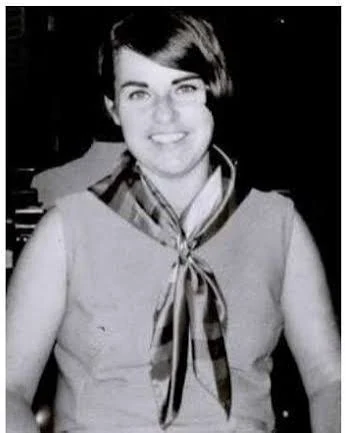
Lass was 25 years old and worked as a nurse at the Sahara Tahoe in South Lake Tahoe. She had previously lived in San Francisco, which is one reason Zodiac writers kept looking at her disappearance once the case entered the mythology.
She was last seen in the early morning hours of September 6, 1970. Her final nurse's-log entry was around 1:50 a.m. Her car was later found parked near her apartment in Stateline. That detail matters because it points the story away from a simple "she drove somewhere and vanished" scenario. If the car was home, then the disappearance likely happened after she left work and reached, or nearly reached, her own orbit.
The next day, an unknown man reportedly called both her employer and her landlord. The caller said Lass had left because of a family emergency. That was false. It looks less like an innocent misunderstanding and more like someone trying to buy time.
Then she was gone.
There is no confirmed Zodiac attack here. No body. No confession with private detail. No physical evidence tying her disappearance to the Bay Area murders. No reliable scene bridge like the bloody shirt from Presidio Heights.
What Lass has is geography, timing, and a card.
The geography is tempting because Lass had a San Francisco connection before Tahoe, and because Tahoe gave Zodiac theorists a new terrain to search. The timing is tempting because the disappearance came after the canonical 1968-1969 attacks, during the period when Zodiac's correspondence was still active and his claimed victim count was rising.
The card is the real engine.
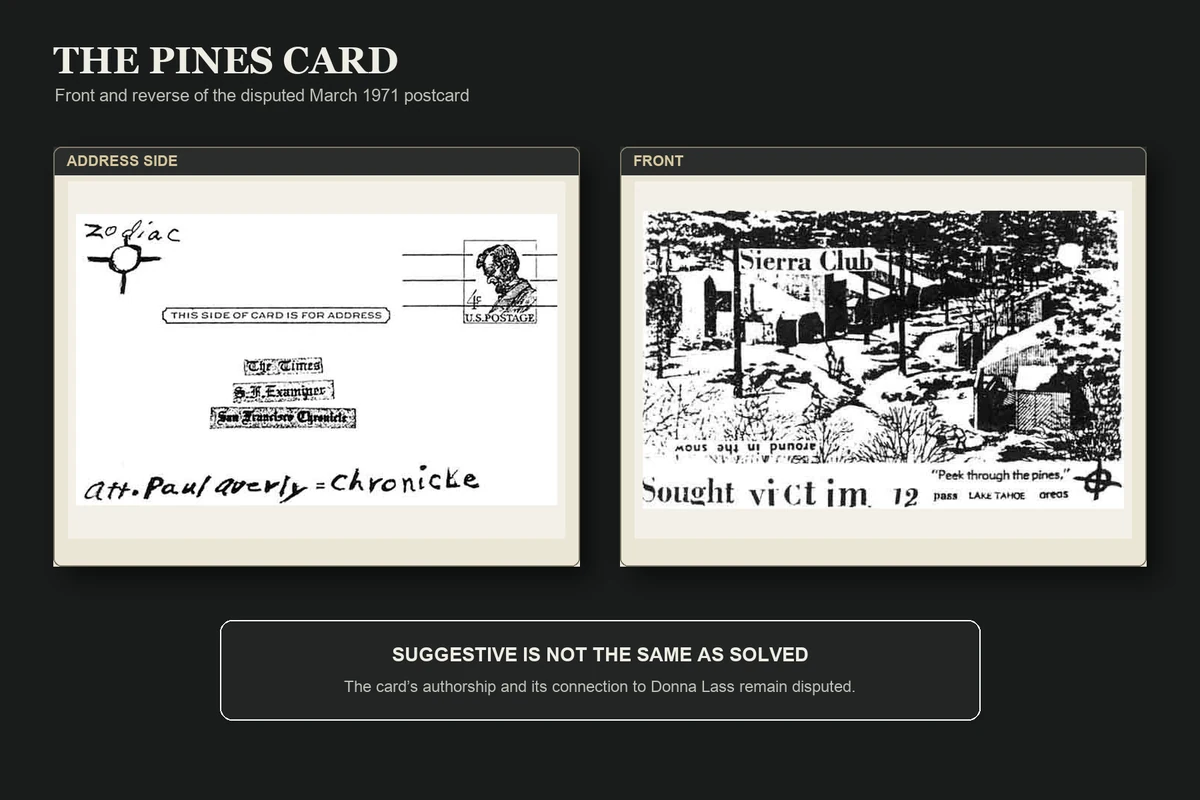
In March 1971, the Chronicle received the so-called Pines or Sierra Club card. It used pasted text and imagery that has often been read as an allusion to Lake Tahoe and Donna Lass. But the card's authenticity has been disputed, and even if Zodiac wrote it, it does not prove he abducted or killed Lass. Zodiac could imply. Zodiac could borrow. Zodiac could wave toward a missing woman because he liked the way the shadow lengthened when he stood near it.
Missing-person cases are especially vulnerable to this.
An unsolved murder at least has a crime scene. A missing-person case often has a vanishing point, a handful of last sightings, a few strange calls, and an ocean of absence. That absence invites meaning. It makes people want the open case to plug into a famous one because a terrible answer can feel better than no answer at all.
That is a human impulse, not an evidentiary standard.
Donna Lass deserves to be remembered as Donna Lass before she becomes a prop in Zodiac's theater. Her disappearance may deserve investigative attention. The card may deserve careful discussion. But her name should not be added to the confirmed Zodiac dead because a collage points toward pines.
Heat: low to moderate disputed-card heat, not confirmed.
The Outer Ring
The further we move from the confirmed Zodiac crimes, the easier it becomes to confuse resemblance with relationship.
That does not mean the outer-ring cases are worthless. Some are worth a look. But they need to stay short unless the evidence earns more space.
Not every person or couple killed in a car, near a car, on a lonely road, in a secluded place, by a gun, with a knife, or within shouting distance of California becomes Zodiac property. At some point the category "things murderers do" has to remain larger than one murderer's resume.
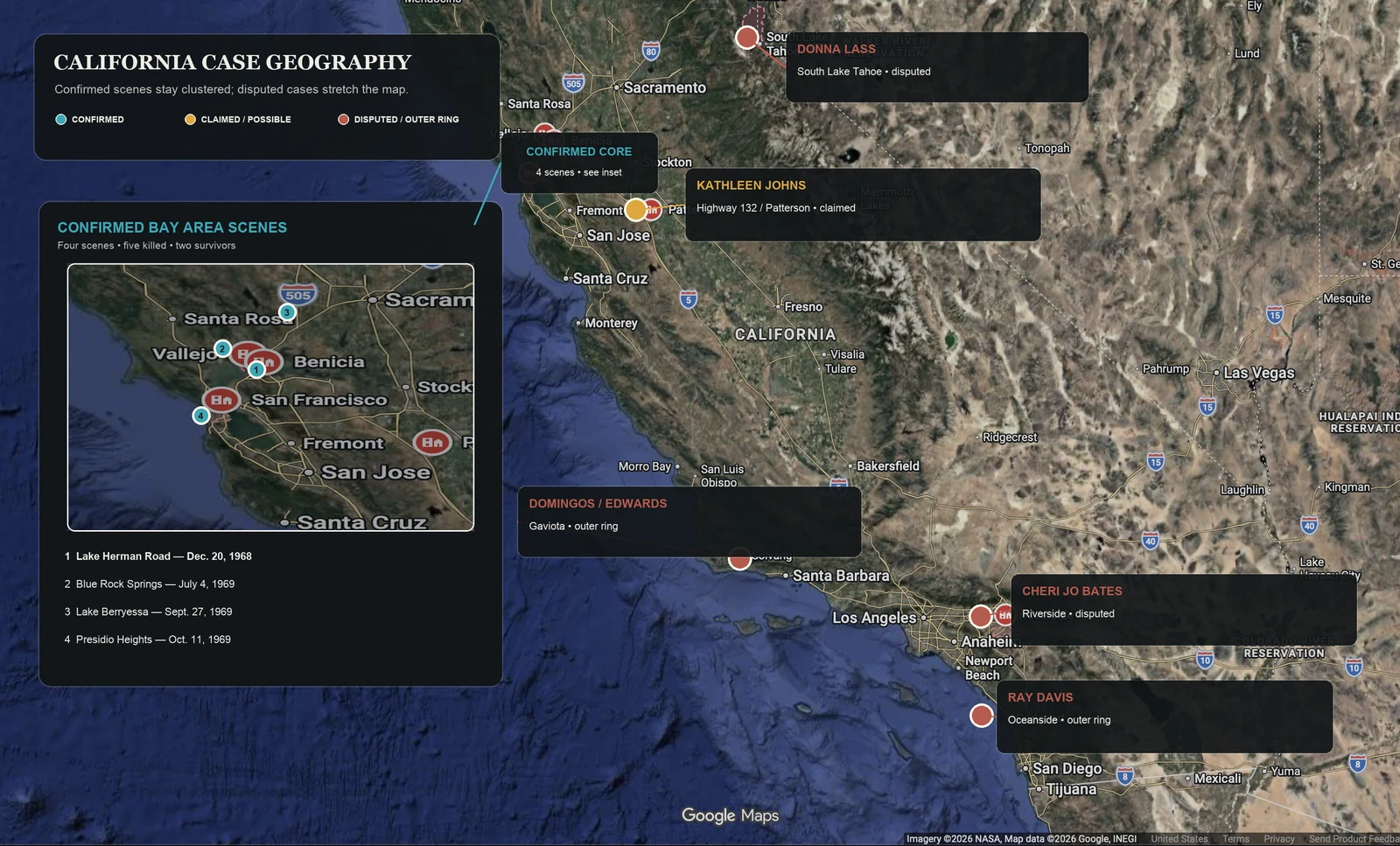
Ray Davis is one of the more striking outer-ring cases because he was also a cab driver. Davis was murdered in Oceanside on April 10, 1962. He was 27 years old and drove for Checker Cab. Late that night, he picked up a fare from a downtown cab stand and told his dispatcher he was taking the passenger toward South Oceanside.
He did not return.
The next morning, Davis's body was found in Saint Malo, an upscale Oceanside neighborhood. He had been shot from behind while in his cab. The cab itself was later found abandoned elsewhere. Available case summaries describe .22 long-rifle ammunition and no obvious robbery motive.
Then comes the part that makes Zodiac readers sit up. The Davis material includes police calls connected to the crime: advance warning of a baffling crime, later credit-taking, and a threat involving a bus driver. That echoes Paul Stine, the Zodiac phone-call habit, and the later bus-threat letters loudly enough to get attention.
But 1962 is very early. Oceanside is far south of the confirmed Zodiac geography. Echoes can mean many things: the same offender, a copied pattern, a coincidence, or a later reader imposing a pattern backward. If the Davis case ever produced a forensic bridge to Zodiac, that would matter. Without it, Davis belongs in the "interesting, unresolved, do not inflate" folder.
Robert Domingos and Linda Edwards are more famous in Zodiac discussion. They were teenagers from Lompoc High School, 18 and 17 years old, and were killed on June 4, 1963, on a remote beach south of Gaviota in Santa Barbara County.
They had gone to the beach during "Senior Ditch Day," when classmates were marking the end of school. Instead of joining a larger group, Domingos and Edwards were alone in an isolated place. The public case summary says the killer approached while they were sunbathing. Edwards was apparently forced to bind Domingos with rope, and both teenagers tried to flee. They were shot repeatedly with a .22 caliber weapon.
Afterward, the killer moved the bodies to a nearby shack and tried unsuccessfully to set it on fire. There was no evidence of robbery or sexual assault. The case has always had the dead, pointless cruelty that makes people reach for a pattern.
The Zodiac comparison is obvious enough to explain. A young couple in a remote outdoor setting. Rope. A firearm. An attempt to control victims. A strange, motiveless attack. Later writers also point to ammunition similarities with Lake Herman Road and the couple-control elements that seem to anticipate Lake Berryessa.
The resemblance is real enough to be uncomfortable.
It is not real enough to be confirmation.
Domingos and Edwards were killed more than five years before Lake Herman Road and more than six years before Lake Berryessa. A remote young couple, a gun, rope, and a failed attempt at control can suggest a behavioral cousin. It can also describe more than one violent offender. If we call every resemblance a fingerprint, then the word fingerprint has become decorative.
The Santa Barbara material deserves mention because serious people have looked at the possibility. It should not be made to carry more than that.
There are other names in the broader Zodiac weather system: Johnny and Joyce Swindle, Officer Richard Radetich, and additional cases pulled toward Zodiac by claimed counts, geography, or a passing similarity. Some may deserve later addenda if stronger source packets turn up. But this cannot become a museum of every unsolved California crime that has ever had a Zodiac label stuck to it.
That way lies madness, and probably a 900-page forum thread.
Why The Phantom Case Exists
The phantom case exists because Zodiac built it.
Not alone. He had help. Newspapers helped. Police silences helped. Fragmented agencies helped. Later books helped. Message boards helped. Podcasts helped. People like me, writing too many words in the year of our Lord 2026, do not get to pretend we are innocent of feeding the machine.
Even the official file eventually had to live with the mess. In April 1978, after years of public Zodiac silence, a new letter appeared with the old voice trying to climb back on stage. Its authenticity was challenged, and document examiners disagreed about whether Zodiac had really written it. Then the story bent sideways. Newspaper material preserved in the FBI files reported that SFPD Inspector David Toschi had been moved to another detail after admitting that, years earlier, he had written self-praising fan letters under false names to Armistead Maupin, the Chronicle writer whose fiction had included a Toschi-like detective. That was the known misconduct. The speculation was worse: some wondered whether Toschi might also have written the April 1978 Zodiac letter. Toschi denied that, and police reporting said there was no evidence he had written the Zodiac communication.
That is the late Zodiac file in miniature: a disputed letter, a famous detective, real vanity, public suspicion, handwriting disagreement, and a case so myth-soaked that even the people investigating it could become part of the mythology. None of that erases the authenticated shirt-piece letters from 1969. It does mean the later correspondence cannot be treated as one clean, continuous voice just because it arrived wearing the right mask.
But Zodiac created the first vacuum.
He claimed more victims than investigators could prove. He used letters to move the case from police work into public performance. He wrote as if he had a hidden ledger somewhere, one only he could balance. Every time he raised the count without proof, he invited everyone else to go hunting for bodies that might belong to him.
That is part of the cruelty.
The confirmed victims become the foundation. The disputed victims become shadows. The shadows become arguments. The arguments become suspect fuel. A suspect theory may need Bates to be Zodiac, so Bates gets pulled harder. A theory may need Lass, so the Pines card gets louder. A theory may need a longer career, so Davis or Domingos and Edwards get dragged closer to the center.
This is not how evidence should work.
A suspect theory should not be allowed to expand the victim list just because it needs more room to breathe. The victim list should constrain the suspect theory. If the theory only works by turning disputed cases into confirmed ones, the theory is not solving the Zodiac case. It is remodeling the house while the body is still inside.
That is why this article matters before the final courtroom piece.
Before we can ask who Zodiac was, we have to ask what Zodiac even did.
And the honest answer is smaller than his myth.
Where This Leaves Us
Cheri Jo Bates is the strongest disputed case because official comparison work, letters, and vehicle-disabling material make the question serious.
Kathleen Johns is the strongest claimed survivor case because Zodiac appeared to pull her story into his correspondence, but did not prove it.
Donna Lass is a missing woman whose disappearance deserves attention, but whose Zodiac connection still depends heavily on a disputed card and suggestive geography.
Ray Davis and Domingos/Edwards are outer-ring cases with disturbing echoes, not confirmed bridges.
That is not a tidy conclusion. Good. Tidy would be suspicious.
The confirmed Zodiac case is already enough: Lake Herman Road, Blue Rock Springs, Lake Berryessa, Presidio Heights, the letters, the calls, the ciphers, the shirt, the public terror. We do not need to pad the count to make him frightening. He was frightening because of what can be proved.
The phantom case tells us something else.
It tells us how a killer can keep hurting the truth long after the attacks stop. He can leave behind open doors. He can make police chase shadows. He can make families watch their loved ones become evidence in someone else's mythology. He can make every unsolved case near the right date and geography feel like it might be part of the same nightmare.
Some of those shadows may yet matter.
But they are still shadows.
And shadows do not get counted as bodies.
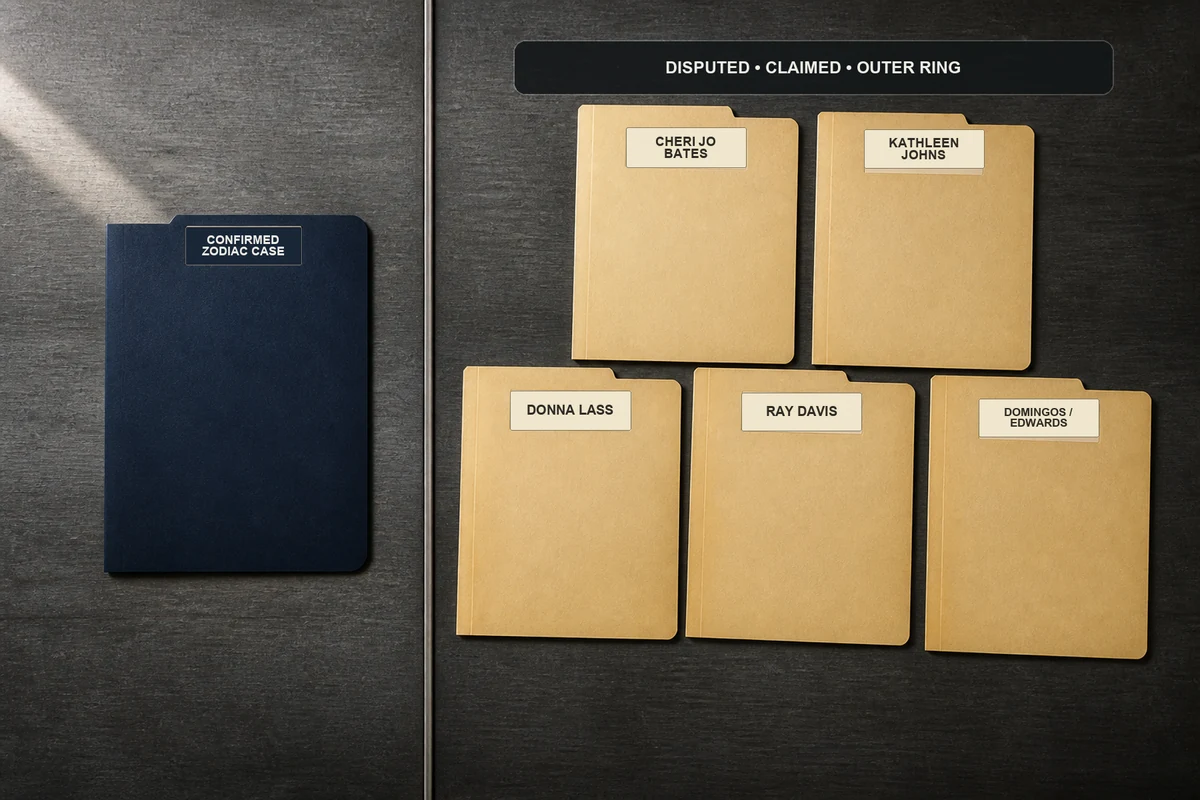
Coming Up: The Trial Of A Ghost
Now we have the whole mess on the table.
The confirmed attacks. The letters. The ciphers. The shirt. The police near-miss. The suspect circus. The phantom victims.
So in the final article, we do the only thing left to do.
We put the ghost on trial.
Not because the trial can name him. It cannot.
Because a courtroom is the right place to ask the question Zodiac hated most:
What can you actually prove?
Discussion
Thoughtful, good-faith discussion is welcome.
Loading comments…